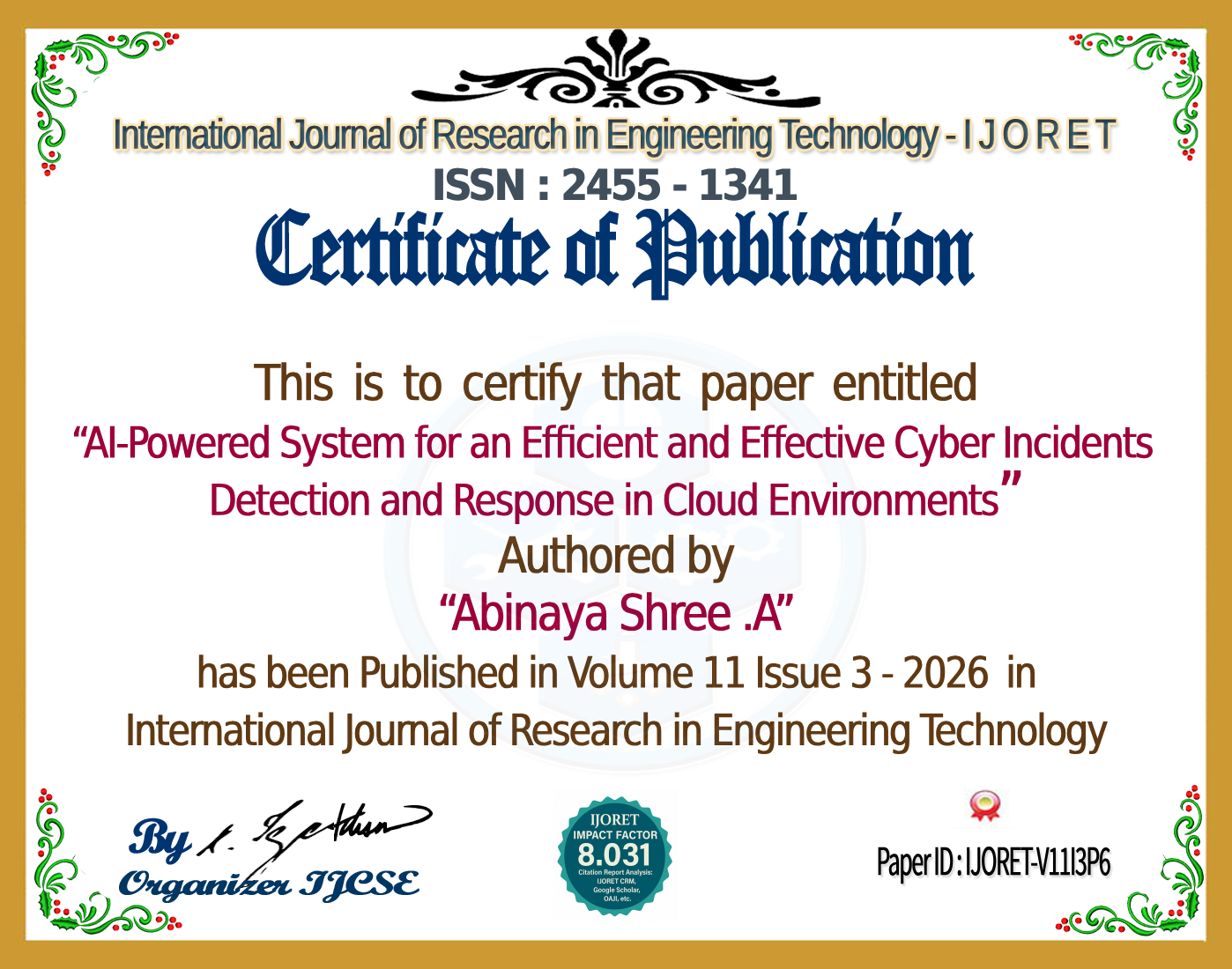
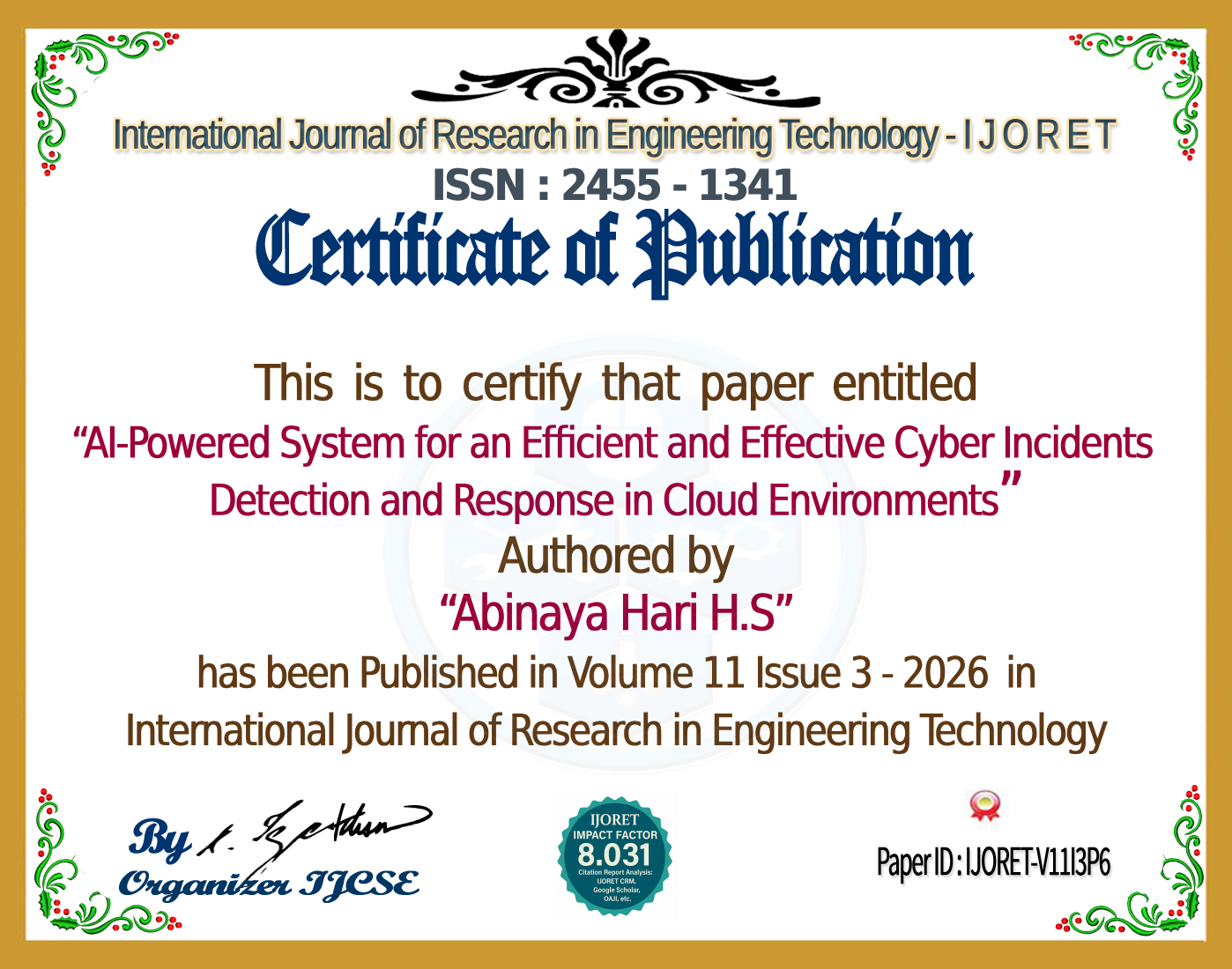
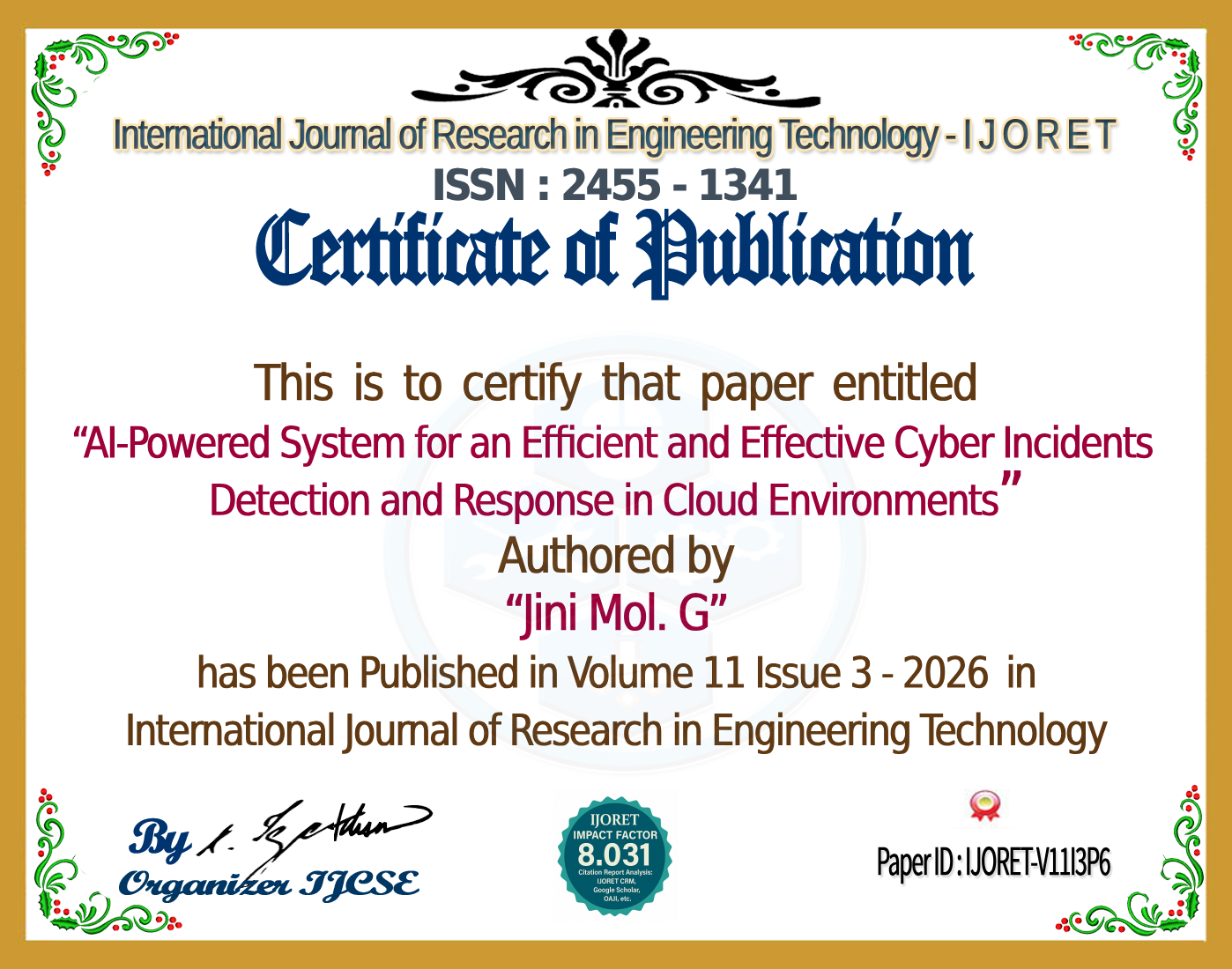
AI-Powered System for an Efficient and Effective Cyber Incidents Detection and Response in Cloud Environments | IJORET – Volume 11- Issue 3 | IJORET-V11I3P6

International Journal of Research in Engineering & Technology (IJORET)
Innovative Peer-Reviewed Open Access Journal – ISSN: 2394-4893
[Citation & SEO Info]



Volume 11 , Issue 3 | Published: May – June 2026
Article Author(s)
Agnel Macdalin .A, Abinaya Shree .A, Abinaya Hari H.S, Jini Mol. G
Abstract
Cloud computing has become a game-changing technology that lets businesses store, process, and manage data quickly and easily using infrastructures that can grow and change as needed. Even though there are many benefits to using the cloud, the rapid growth of cloud adoption has made people much more vulnerable to cyber threats like data breaches, distributed denial-of-service (DDoS) attacks, malware infections, and unauthorized access. These threats put sensitive data and important applications hosted in the cloud at serious risk. Signature based and rule-based intrusion detection systems are examples of traditional cybersecurity tools that don’t work well against modern cyber attacks. These systems depend on patterns that have already been set up and can’t find new or zero-day threats. Also, the fact that cloud environments are dynamic and spread out means that they create huge amounts of data, which makes it very hard and time-consuming to monitor and analyze by hand. This paper suggests an AI-powered system for detecting and responding to cyber incidents in cloud environments to deal with these problems. The suggested system has a number of smart modules, such as classifying network traffic, detecting web intrusions, and analyzing malware after an incident. Machine Learning algorithms like Random Forest are used to sort network traffic and find intrusions, while Deep Learning models are used to find and analyze advanced malware. The system uses a containerized architecture to make sure it can grow, move, and be deployed quickly and easily on cloud platforms. The proposed framework greatly shortens response time, cuts down on the need for human intervention, and increases detection accuracy by automating the processes of finding and responding to threats. The results show that the system can accurately identify both known and unknown threats, making it a reliable way to improve cloud security.
Keywords
AI, ML, Cybersecurity, Cloud Computing Security, Cyber Incident Detection, Incident Response SystemConclusion
Cyber incident detection and response systems driven by AI offer a cutting-edge and effective method of protecting cloud infrastructures. AI-based solutions provide dynamic and intelligent threat detection, in contrast to traditional security systems that rely on predetermined criteria. They are very effective against sophisticated cyberattacks because they can recognize patterns, spot anomalies, and react to threats instantly.
These systems offer a number of important advantages, including as enhanced scalability, automated incident response, and quicker threat identification. Automation guarantees that threats are dealt with quickly and lessens the workload for security professionals. AI systems can also adjust to new and changing threats, which makes them appropriate for intricate and quickly expanding cloud infrastructures.
Although there are obstacles such model complexity, high implementation costs, and data dependency, these can be overcome with the right approaches. System performance and dependability can be increased by ensuring high-quality data, regularly training models, and integrating them with current security frameworks. Artificial intelligence and cybersecurity developments will improve these systems even more as technology develops.
To sum up, AI-powered solutions are essential to contemporary cloud security. They boost the general resilience of cloud systems in addition to increasing the effectiveness of cyber event detection and response. AI advancements in the future will be crucial in defending businesses against ever-more-advanced cyberattacks.
References
[1] “AI in Medicine Supply Chain,” IEEE Transactions on Biomedical Engineering, 2024.
[2] “Blockchain for Drug Authentication,” IEEE Access, 2023.
[3] World Health Organization, “Counterfeit Drug Report,” 2022.
[4] “IoT-Based Inventory Management,” IEEE Systems Journal, 2023.
[5] J. Smith, R. K. Patel, and M. Brown, “Artificial Intelligence for Predictive Healthcare Supply Chains,” IEEE Trans. Comput. Intell. Healthcare, vol. 8, no. 4, pp. 112–124, 2023.
[6] L. Wang, P. Gupta, and H. Lee, “Blockchain-Enabled Pharmaceutical Supply Chain Management: A Review,” IEEE Access, vol. 11, pp. 65432–65445, 2024.
[7] S. Davis and K. Martinez, “IoT-Driven Medication Tracking System for Hospitals,” IEEE Systems Journal, 2023.
[8] A. Kumar and S. Raj, “Smart Healthcare Inventory Management Using AI and IoT,” International Journal of Healthcare Informatics, vol. 12, no. 2, pp. 45–58, 2024.
[Citation Format]
IJORET Journal Visuals
Journal Front Logo
Indexing Badge
IJORET Important Links
© 2025 International Journal of Research in Engineering & Technology (IJORET).