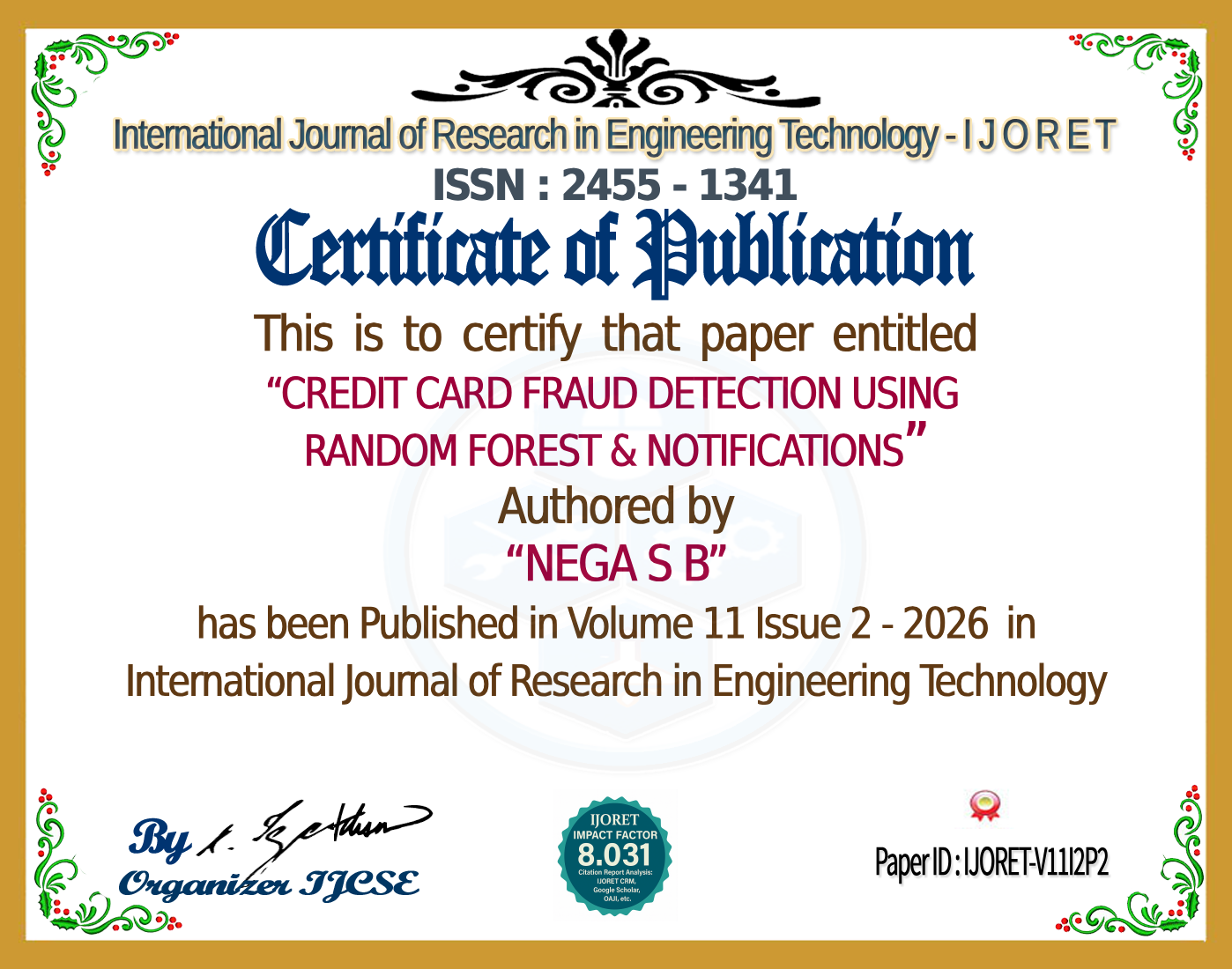
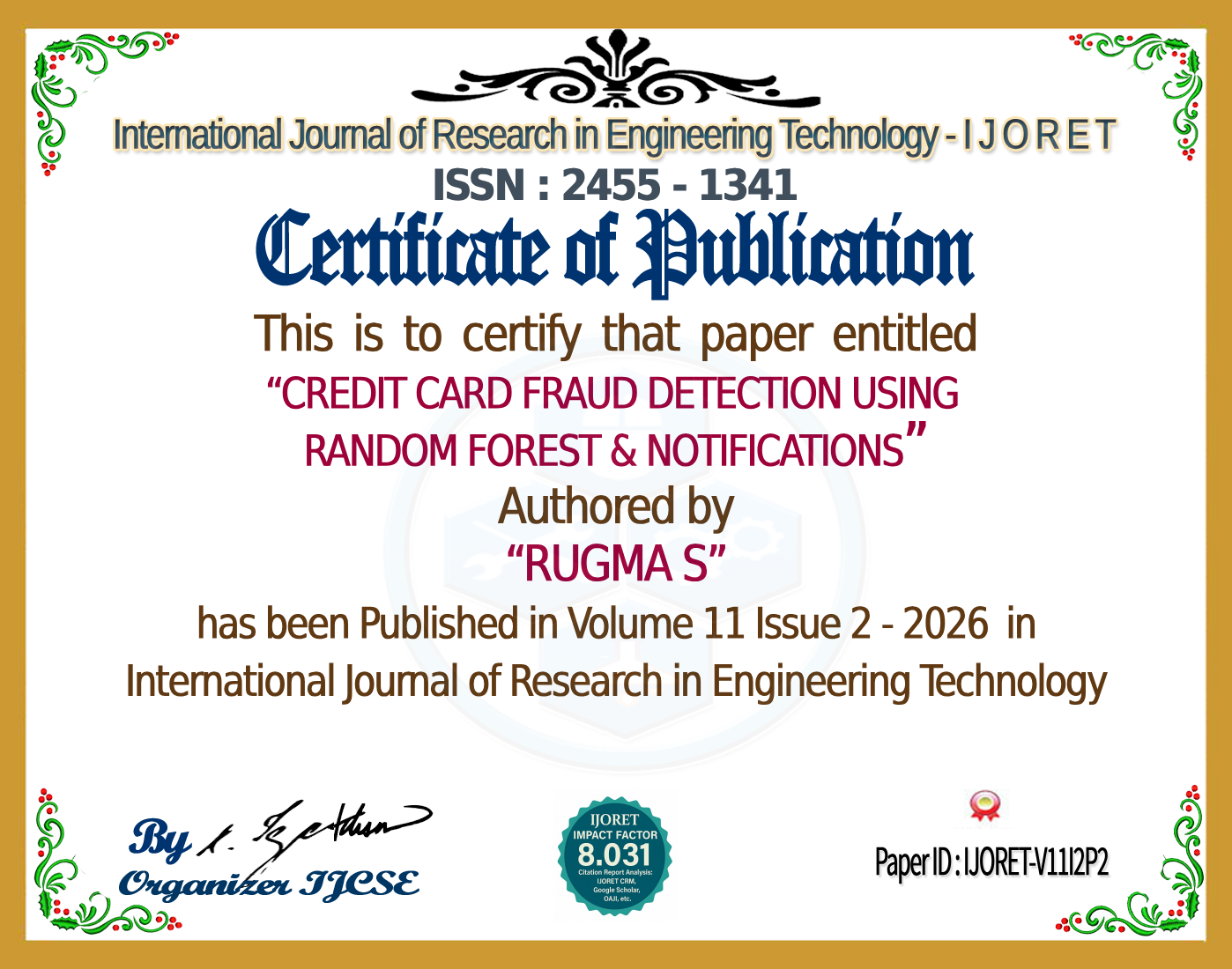
CREDIT CARD FRAUD DETECTION USING RANDOM FOREST & NOTIFICATIONS | IJORET | Volume 11- Issue 2 | IJORETV11I2P2

International Journal of Research in Engineering & Technology (IJORET)
ISSN 2455-1341 • Peer-Reviewed • Open Access • Multidisciplinary
Volume 11, Issue 2 | Published: March – April – 2026
Author
NEGA S B, RUGMA S
Abstract
Credit card fraud has emerged as one of the most critical threats in today’s digital
payment ecosystem, leading to substantial financial losses and compromising customer
trust. Traditional fraud detection mechanisms, while effective to a certain extent, often
struggle to manage the challenges of highly imbalanced transaction data, the dynamic
nature of fraudulent patterns, and the necessity for real-time detection. This project
proposes an intelligent fraud detection framework that leverages the Random Forest
algorithm, a robust ensemble learning method known for its high accuracy and
resilience against overfitting. The model is trained and validated on a benchmark
credit card transaction dataset, where it efficiently learns hidden fraud patterns from
skewed data distributions. To enhance the practicality of the solution, the system is
integrated with an automated notification mechanism that promptly alerts stakeholders,
such as financial institutions and customers, when suspicious or anomalous activities are detected. This real-time alerting feature not only helps mitigate immediate risks but also supports proactive decision-making in fraud prevention. Experimental results demonstrate
that the proposed model achieves high accuracy, precision, and recall compared to
conventional approaches, ensuring minimal false alarms while maximizing fraud
detection rates. Furthermore, the system is designed to be scalable and adaptable,
making it suitable for deployment in diverse financial environments. Overall,
this project presents a reliable, efficient, and user-centric fraud detection system
that significantly contributes to safeguarding digital transactions in the evolving financial landscape.
Keywords
^Conclusion
This project titled “Credit Card Fraud Detection Using Random Forest and Notifications” successfully demonstrates the application of machine learning techniques to detect fraudulent credit card transactions efficiently and accurately. With the increasing adoption of online payment systems, fraud detection has become a critical requirement for financial institutions. Traditional rule-based systems are no longer sufficient due to their inability to adapt to evolving fraud patterns.
The proposed system utilizes the Random Forest algorithm, which effectively handles large, complex, and highly imbalanced datasets. Through proper data preprocessing, model training, and evaluation, the system achieved high accuracy (approximately 99%), along with strong precision, recall, and ROC-AUC values. This confirms the reliability and robustness of the model in distinguishing between legitimate and fraudulent transactions.
Additionally, the integration of an automated email notification system enhances real-time fraud prevention by immediately alerting users or banks when suspicious activity is detected. This proactive approach helps reduce financial loss and improves customer trust.
Overall, the project meets its objectives by providing a scalable, accurate, and efficient fraud detection system, making it suitable for deployment in real-world banking and fintech environments.
References
1.Dal Pozzolo, A., Bontempi, G., Snoeck, M., & Snoeck, C., “Adapting machine learning models to concept drift in credit card fraud detection,” IEEE Intelligent Systems, 2014.
2.Bhattacharyya, S., Jha, S., Tharakunnel, K., & Westland, J.C., “Data mining for credit card fraud: A comparative study,” Decision Support Systems, 2011.
3.Whitrow, C., et al., “Transaction aggregation as a strategy for credit card fraud detection,” Data Mining and Knowledge Discovery, 2009.
4.Kaggle Dataset – Credit Card Fraud Detection
https://www.kaggle.com/mlg-ulb/creditcard
5.Scikit-learn Documentation
https://scikit-learn.org
Python Official Documentation
https://docs.python.org
Journal Visuals

Indexing Overview
Download Image

Google Scholar Readiness
View

Scope Snapshot
Open
Official IJORET Logo
Download
IJORET Important Links
Multidisciplinary research welcomed across engineering and technology. Publish with strong visibility, DOI, and rigorous peer review.
High Impact Submission© ^ Year International Journal of Research in Engineering & Technology (IJORET).