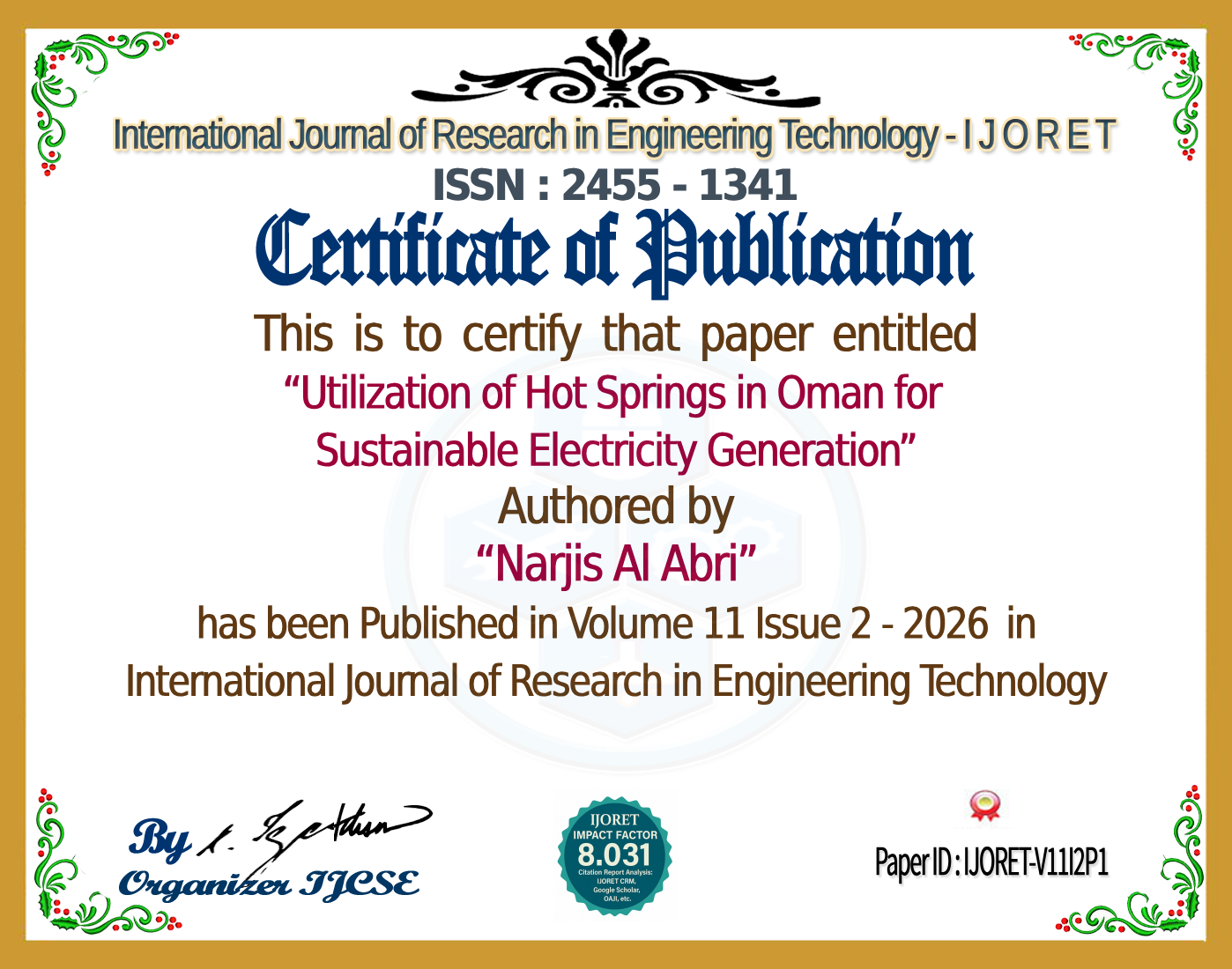
Utilization of Hot Springs in Oman for Sustainable Electricity Generation | IJORET | Volume 11- Issue 2 | IJORET-V11I2P1

International Journal of Research in Engineering & Technology (IJORET)
ISSN 2455-1341 • Peer-Reviewed • Open Access • Multidisciplinary
Volume 11, Issue 2 | Published: March – April – 2026
Author
Narjis Al Abri
Abstract
This study investigates the feasibility of utilizing naturally occurring hot springs in Oman as a sustainable source of electricity generation. Oman’s electricity sector is still largely dependent on natural gas, creating long-term concerns related to energy security and environmental sustainability. Several hot spring locations, including Al Kasfah Hot Spring and Nakhl Hot Springs, provide continuous geothermal water flow with moderate temperatures that can be exploited using low-temperature geothermal technologies.
The research proposes an integrated system that utilizes thermal energy, kinetic energy from water flow, and low-pressure steam to generate electricity. The primary technology considered is the binary cycle system, particularly the Organic Rankine Cycle (ORC), which is well suited for low-enthalpy geothermal resources. A hybrid configuration combining heat exchangers, micro-hydraulic turbines, and compact steam turbines is suggested to maximize energy recovery.
Environmental analysis indicates that geothermal power derived from hot springs has a very low carbon footprint, especially when reinjection strategies are applied to maintain reservoir sustainability and protect natural ecosystems (DiPippo, 2016). Economically, small-scale modular systems are shown to be attractive due to
relatively low operating costs and the absence of fuel requirements (Lund & Boyd, 2016). The study also highlights the importance of regulatory frameworks, environmental impact assessments, and community engagement in ensuring successful project implementation.
The results demonstrate that hot spring–based electricity generation can contribute to national energy diversification strategies, reduce greenhouse gas emissions, and support decentralized power supply in rural and touristic regions. The study concludes that geothermal energy from hot springs represents a promising and underutilized renewable resource for Oman’s future sustainable energy development.
Keywords
^Conclusion
This condensed study confirms that hot springs in Oman can be effectively utilized for electricity generation using low-temperature geothermal technologies. A hybrid system combining thermal, kinetic, and steam energy recovery provides an efficient and environmentally responsible solution. With proper planning, regulatory support, and pilot implementation, hot spring–based geothermal power can become an important complementary component of Oman’s renewable energy portfolio.
References
^
Journal Visuals

Indexing Overview
Download Image

Google Scholar Readiness
View

Scope Snapshot
Open
Official IJORET Logo
Download
IJORET Important Links
Multidisciplinary research welcomed across engineering and technology. Publish with strong visibility, DOI, and rigorous peer review.
High Impact Submission© ^ Year International Journal of Research in Engineering & Technology (IJORET).